
UV Nail Lamp vs LED Nail Lamp: Cure Speed Compared
Tutorial
Key Takeaways
- UV lamps use phosphor-coated fluorescent tubes and cure in 2 to 3 minutes; LED lamps use diodes and cure in 30 to 60 seconds.
- LED does not cure every gel. The photoinitiator chemistry decides compatibility, not the wattage on the box.
- Tubes need replacing every 3 to 6 months in a busy salon. LED arrays are rated past 20,000 hours.
- Dual-wavelength 365+405 nm output covers both photoinitiator families, which is why every lamp we build runs both.
- Going above 96W mainly buys even coverage across a full hand, not a faster cure on a single nail.
120W
Peak lamp power (ES-601PRO)
365+405nm
Dual-wavelength output
12,000sqm
In-house factory floor
100+patents
Held across product lines
A salon owner in Dubai asked us last month why her 48W LED lamp cures builder gel in 60 seconds while the unit two stations over finishes in 30. The difference came down to diode count, wavelength, and reflector geometry.
The uv nail lamp vs led nail lamp question gets framed as old versus new, but the physics is narrower than that. Both devices emit UVA. One uses phosphor-coated tubes. The other uses diodes. That single change drives cure time, replacement cost, and how long the unit survives a 12-hour shift.
What actually separates a UV lamp from an LED lamp
Strip the housing off both units and the difference is obvious. A fluorescent UV lamp holds one to four tubes, each coated with a phosphor blend that converts mercury emission into UVA between roughly 350 nm and 400 nm. Peak output is broad. It also drifts as the tube ages, which is why a two-year-old tube cures slower than a new one at the same wattage.
An LED lamp holds an array of individual diodes. Each emits at a fixed wavelength, usually 365 nm, 405 nm, or both. There is no warm-up period, and there is no phosphor layer to fade.
Both are UVA devices. Neither belongs in the same category as a UVB tanning bed, a comparison we still see printed in distributor catalogues and it does the category no favors.
Why 'UV gel' and 'LED lamp' are not opposites
Most gel formulas sold today cure under either source. The deciding factor is the photoinitiator. Some initiators absorb strongly below 365 nm, and those formulas will undercure under a 405 nm-only lamp even if the wattage is high. Others peak in the 380 to 420 nm band and cure in seconds under LED. If a client brings her own gel, test a swatch on a clear tip before you commit her full set.
| Spec | Fluorescent UV lamp | LED lamp |
|---|---|---|
| Light source | 1 to 4 phosphor tubes | Diode array, 1 to 48+ beads |
| Typical cure time | 120 to 180 seconds | 30 to 60 seconds |
| Wavelength | Broad, 350 to 400 nm | Fixed at 365 nm, 405 nm, or both |
| Rated life | 1,000 to 2,000 hours | 20,000+ hours |
| Heat output | Higher, tubes run warm | Lower, diodes run cooler |
| Best fit | Legacy gel formulas | Modern LED/UV hybrid gels |
Cure speed: what actually changes it
Two lamps both rated 48W can cure at completely different speeds. Wattage is a total figure for the whole unit, not a dose delivered to the nail plate. Four things matter more.
- Bead count and spacing. A 48-bead array spreads the same wattage across more emitters, so no single diode overheats and coverage stays even.
- Reflector geometry. Light that escapes sideways never reaches the gel. A shaped reflector cup bounces it back toward the nail.
- Distance. Moving a hand 2 cm further from the emitters can cut the dose by more than half.
- Gel thickness. A 2 mm bead of builder gel cures from the top down. Overbuild it and the bottom stays wet no matter which lamp you own.
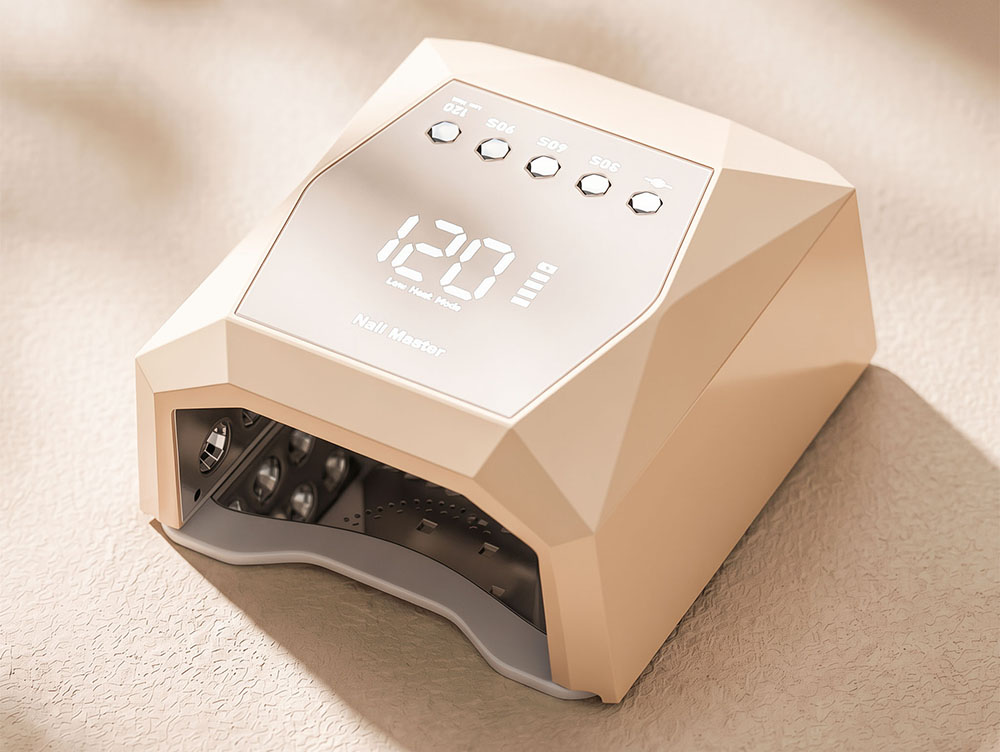
Our ES-601 runs 96W through 48 LEDs at 365+405 nm, and the ES-601PRO pushes the same array to 120W with a 5200mAh battery for cordless use. That extra headroom is about holding intensity across a full hand of five nails, not about shaving three seconds off a single thumb.
⚠
Undercuring is the expensive mistakeGel that feels hard on top but never fully polymerized will lift at the sidewalls within days. Clients blame the gel brand. The lamp usually did it.
✓ Pros
- LED cuts service time by roughly two thirds compared with fluorescent tubes.
- Lower heat output keeps clients comfortable during longer builder gel cures.
- No bulb inventory and no monthly tube replacement routine for the salon.
- Cordless models with 5200mAh batteries free up the station from wall sockets.
✗ Cons
- A 405 nm-only LED lamp will not properly cure older UV-only gel formulas.
- Diode arrays and driver boards cost more to repair than a simple tube swap.
- Cheap units with low bead counts leave the thumb and pinky edges undercured.
Lifespan and the real cost per year
Fluorescent tubes are consumables. In a salon running eight clients a day, tubes typically need rotating and replacing every 3 to 6 months, and the output curve is already falling well before a tube visibly darkens at the ends. That is a recurring line item and a recurring reminder to staff.
LED diodes degrade too, but slowly. A rated 20,000 hours at 45 seconds per cure works out to a service life measured in years, not months. When an LED lamp does fail, it is usually the driver board, moisture ingress, or a cracked solder joint rather than the emitters themselves.
Our R&D team runs each reflector cup design against a flat target to confirm the corners of a nail plate receive the same dose as the center. In a 12,000 sqm factory we can go from a revised cup drawing to a molded sample without leaving the building, which is why lamp revisions move in weeks instead of quarters.
Reading a lifespan claim properly
A 20,000-hour rating assumes thermal management keeps the junction temperature in range. Diodes packed into a small housing without airflow will fall short of that number. Look at bead spacing and housing vents before you trust the spec sheet.
Why our lamps run 365+405 nm, not one or the other
Single-wavelength lamps are cheaper to build and easier to market. They also strand part of your client base. A 365 nm emitter handles older and thicker formulas. A 405 nm emitter cures modern LED gels fast and penetrates deeper into clear product. Running both in one array means a salon does not have to ask which gel a client brought in.
Every lamp in our current line uses the 365+405 nm pairing, from the 3W ES-603 flash lamp to the 120W ES-601PRO. The ES-606 runs 45 beads at 115W with a 5200mAh battery, and the ES-E607 adds a 5V 2A USB output so a station can charge a phone off the same unit. For mobile techs, the 18W ES-610 table lamp drives three beads at 2000mAh and fits in a kit bag.
💡
Check the wavelength label, not the marketing nameAny lamp that lists only 'UV LED' without a nm figure is hiding something. Ask for the emitter spec sheet before you place a bulk order.
Sourcing lamps for a salon chain or a distribution line
Buying for one station and buying for 200 stations are different problems. Chains need plug consistency across regions, a warranty that covers a full rollout, and a parts pipeline that survives staff turnover. Distributors need tiered pricing, stable batch quality, and packaging that survives a container.
We hold a 500-unit OEM minimum and run prototypes in 1 to 2 weeks, with production at 30 days. Customization covers logo, color matched to any RAL or Pantone reference, six packaging formats including suitcase and zippered gift box, and plug types for EU, UK, US, AU, and Type-C. All units ship with CE, FDA, RoHS, and ISO 9001 documentation, and a 1-year warranty.
What we see with distributors is that lamp returns cluster around two things: cordless batteries that were never cycled properly in the first month, and lamps sold into markets with the wrong plug adapter. Both are preventable with a line in the user manual, which we translate for you.
| Buyer type | Priority | Recommended spec |
|---|---|---|
| Mobile tech | Portability and battery | ES-610 18W table lamp or ES-602 9W flash lamp |
| Single salon station | Full-hand coverage | ES-601 96W, 48 beads, 2600mAh |
| High-volume salon | Throughput and cordless runtime | ES-601PRO 120W or ES-606 115W, 5200mAh |
| Regional distributor | Batch consistency and packaging | Full 3W to 120W range with custom branding |
Frequently Asked Questions
Is a UV nail lamp dangerous for clients?
Both lamp types emit UVA, and the FDA regulates nail lamps as radiation-emitting products. The practical control is total exposure, not the label on the housing. An LED lamp cuts a cure from about 3 minutes to 45 seconds, so the cumulative UVA dose per service drops even though peak intensity is higher. Clients on photosensitizing medication should still be flagged before every service.
Will an LED lamp cure my existing UV gel stock?
Only if the formula's photoinitiator absorbs at the lamp's wavelength. Test it: cure a thin swatch on a clear tip for the normal cycle, then press and twist. If it smears or feels tacky underneath, the gel needs a lower wavelength. Our dual 365+405 nm arrays cover both initiator families, which removes most of the guesswork.
How many watts does a salon nail lamp actually need?
48W is the practical floor for covering a full hand evenly. At 96W and above you are buying coverage and cordless runtime rather than raw speed. The ES-601 at 96W with 48 beads handles a standard LED gel cycle in 30 to 45 seconds per hand.
Do LED nail lamps ever need replacement bulbs?
No. There are no bulbs to swap. Diodes degrade slowly over thousands of hours, and when a lamp dies the usual culprits are the driver board, moisture, or a cracked solder joint. That is one reason LED running costs stay lower than tube lamps over a three-year span.
Why does my lamp cure thumbs and pinkies poorly?
Those nails sit at the edge of the light cone, where intensity falls off. Rotate the hand halfway through the cycle so each side gets a turn under the center of the array. A lamp with a higher bead count and a shaped reflector cup, rather than more total wattage, is the real fix.
Key Takeaways
- Specify wavelength before wattage. A 365+405 nm array removes the gel compatibility question entirely.
- Budget tube replacements every 3 to 6 months if you still run fluorescent lamps; the LED equivalent has no such line item.
- For a multi-station rollout, standardize on one model per region so plug types and spare parts stay consistent.
- Ask any supplier for the emitter spec sheet and a batch quality report before signing a bulk order.
Conclusion
The cure-speed gap between uv vs led nail lamp technology is real, but it is a wavelength and coverage story rather than a brand story. Match the emitter to the gel chemistry, check bead count against hand size, and the lamp decision becomes straightforward. If you are sourcing for a chain or a distribution line, send us your gel brand and target cure time. We will match a model from the 3W to 120W range, quote at the 500-unit OEM minimum, and have a branded prototype in your hands within 1 to 2 weeks.