
Semi Cured Gel Nail Strips: File & Shape with a Drill
Tutorial
Key Takeaways
- Shaping lives between 5,000 and 15,000 RPM. Save 25,000 RPM and up for bulk removal in the middle of the nail.
- Diamond bits for edges and cuticle lines, tungsten carbide for shortening thick cured gel.
- Test-fit before you file. Width problems cannot be fixed with a bit, only with a different size.
- If the nail feels warm against your hand, stop. Heat cracks press-ons faster than pressure does.
12,000sqm
In-house smart factory
0-35,000RPM
Standard drill speed range
100+patents
Nail equipment patents
13years
OEM/ODM experience since 2012
Press-on sets leave the mold almost finished. The last fraction is what your client actually sees. We build nail drills in Guangzhou, and the same edge work we do on press on toenails in the factory is what salons repeat at the table. Semi cured gel nail strips are cured before they ship, so the free edge stays hard and slightly thick instead of flexing away under a hand file. A 30-second pass with the right bit flattens that edge, blends the sidewalls, and seats the nail against the cuticle line. Get the order wrong and you get lifting, heat spikes, and a visible lip that shows in every photo.
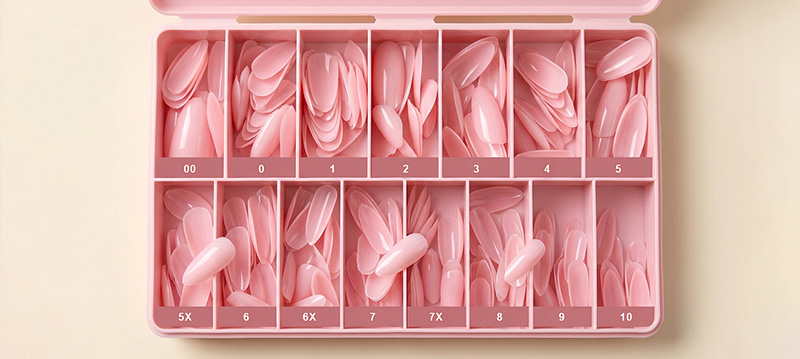
What filing actually does to a press-on nail
Every press-on set leaves the mold with flash along the free edge and a sprue mark near the tip. On a semi cured gel nail strips product, that flash is already cured, so it stays hard instead of peeling away on its own. A hand file rounds it over. A drill cuts it flat.
The free edge is usually the thickest section of the nail. Two light passes with a medium diamond bit at 10,000 RPM remove enough material to sit flush against the natural nail without weakening the structure underneath.
Width matters more than length.
Press on toenails are molded on a standard curve, and a big toe measuring 16 mm across will not fit a tip built for 14 mm. File the sidewalls first. Decide how much length to take off second.
One more thing that surprises new techs: cured gel dust is fine and light. It floats. Without extraction, it settles on the table, the client's hands, and your clothes.
💡
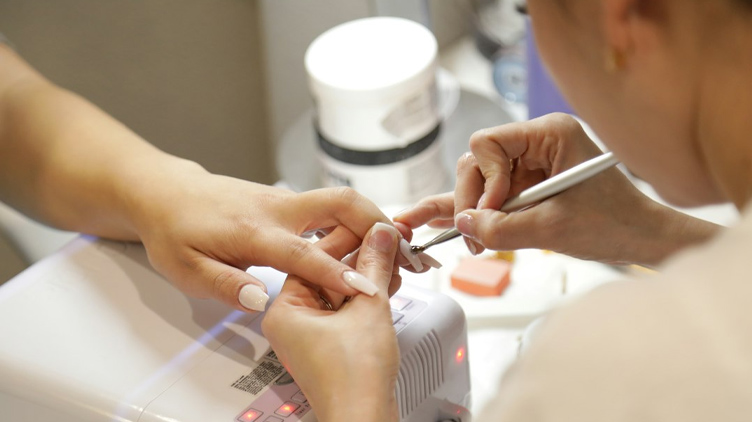
Test-fit before you touch a bitPress the tip onto the nail with no adhesive. If it rocks side to side, sizing is the problem, not shaping. Move down a size before you file anything.
Pick the right bit and RPM for each step
Bit choice controls the finish more than drill power does. Diamond bits cut slowly and leave a fine surface, which suits edges and cuticle lines. Tungsten carbide removes product fast, which suits shortening and thick cured gel.
Speed follows the same logic. Stay under 15,000 RPM for anything near the cuticle. Push higher only when you are removing bulk in the middle of the nail.
Motor type shows up in the finish. Brushless models hold torque at low RPM, so the edge stays flat. Carbon brush motors drop torque under load, which produces scalloped edges when you lean into them.
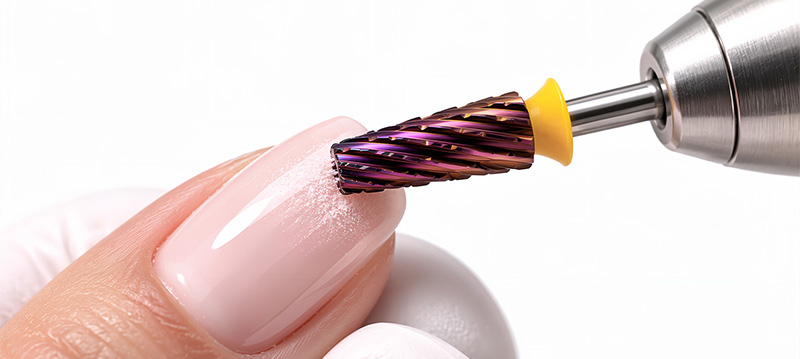
| Task | Bit | RPM range | Model example |
|---|---|---|---|
| Shortening the free edge | Large tapered barrel, coarse carbide | 15,000-20,000 | ES-417 (110W) |
| Thinning sidewalls | Pear shape, X fine carbide | 10,000-15,000 | ES-230 (75W) |
| Blending the cuticle line | Flame shape, fine diamond | 8,000-10,000 | ES-201 (60W) |
| Removing surface shine | Barrel shape, medium diamond | 8,000-12,000 | ES-115 (10W) |
| Final polish | Rounded top barrel, fine diamond | 5,000-8,000 | ES-119 (24W) |
✓ Pros
- Brushless motors hold torque at low RPM, which keeps filed edges flat instead of scalloped.
- A detachable bearing structure extends handpiece life by roughly 40 percent, based on our own bench testing.
- Lighter handpieces such as the ES-119 at 0.125 kg cut wrist fatigue on long sets.
✗ Cons
- Brushless units cost more upfront, so they make sense mainly for high-volume tables.
- Compact cordless bodies cap out between 10W and 24W, which is fine for edges and slow for bulk removal.
Step-by-step: filing a press-on set
Work in this order. Skipping ahead usually means redoing the set.
Step 1: Inspect and test-fit
Wipe the nail with alcohol and let it dry. Test the press-on against each finger and toe. Mark overhanging sidewalls with a pencil. If more than 1 mm hangs over on both sides, size down before you pick up the drill.
Step 2: Shorten the free edge
Use a coarse tungsten carbide bit at 15,000 RPM. Hold the drill at a 15 to 20 degree angle to the free edge and move from the outer corner inward. Do not park the bit in one spot, even for a second.
Step 3: Thin the sidewalls
Switch to a fine diamond pear or flame bit at 8,000 to 10,000 RPM. Two light passes per side. You are removing bulk, not reshaping the whole curve.
Step 4: Blend the cuticle line
Run a fine flame bit along the cuticle edge at 8,000 RPM with almost no pressure. This step is what stops lifting. One pass, feather-light, bit rotating away from the cuticle.
Step 5: Clean and cap
Finish with a rounded top barrel diamond bit at 5,000 RPM, then brush off dust. If you are capping a semi cured strip, seal the free edge and cure under a 365+405 nm lamp for 60 seconds.
Shaping short press on nails and press on toenails
Short sets are less forgiving than long ones. There is no length to hide a bad angle, so the sidewall blend has to be clean. Keep passes short and check the fit after every two.
Toes need a different approach. Press on toenails sit lower on the nail bed and take more lateral pressure from shoes, so the width reduction matters more than the tip shape. File the sides down first, then take length off the free edge. A coarse bit at 12,000 RPM handles the width, a fine diamond handles the finish.
| Style | File direction | Bit | RPM |
|---|---|---|---|
| Short square | Straight across the free edge, corners softened | Large tapered barrel, coarse | 15,000 |
| Short almond | Taper both sidewalls inward | Rounded top barrel, fine diamond | 10,000 |
| Coffin | Parallel sidewalls, straight tip | 5 in 1 PRO cross cut | 12,000 |
| Stiletto | Long taper, very light passes | Tapered tornado, 3X | 8,000 |
| Toe, short | Width first, then length | Barrel shape, medium diamond | 8,000 |
Mistakes that ruin press-on sets
- Pressing hard at high RPM. Pressure makes heat, not speed.
- Dragging the bit sideways across the free edge instead of along it.
- Running the bit toward the cuticle line. Always rotate away.
- Filing a glued nail. Shape first, adhere second.
- Working without dust extraction on cured gel.
- Using one bit for every step, which is the fastest way to glaze a bit and burn an edge.
⚠
Heat cracks more press-ons than pressureTouch the nail to the back of your hand between passes. If it feels warm, stop for 10 seconds. Cured gel gets brittle as it heats, and a hairline crack shows up two days later as a lifted corner.
What this means if you are sourcing press-on sets
Distributors ask us the same question: why do some press-on sets file cleanly and others chip at the tip? It usually comes down to edge thickness tolerance, not the drill. If the free edge varies by more than about 0.3 mm across a box, no bit setting will save the set.
We run tooling, injection molding, assembly, and testing under one roof in a 12,000 sqm factory, which is how edge tolerances stay consistent across a 100,000-unit monthly run. OEM orders start at 500 units, prototypes come back in 1-2 weeks, and production runs 30 days. Certification covers CE, FDA, RoHS, and ISO 9001.
In our factory, every new drill mold gets tested against cured gel tips before it goes into production. That step catches edge geometry problems early, when they are cheap to fix.
Customization you can put on the shelf
Logo, color matched to any RAL or Pantone reference, packaging from flip box to suitcase, and plug types for EU, UK, US, AU, or Type-C. Bulk orders also get marketing images, video, and posters you can use directly.
Frequently Asked Questions
What RPM should I use to file press-on nails?
Stay between 5,000 and 15,000 RPM for anything near the edge or cuticle. Go to 15,000-20,000 RPM only for shortening thick cured gel in the middle of the nail, and never hold the bit in one spot at that speed.
Can I file semi cured gel nail strips after they are cured?
Yes, and you should. Cured strips have a hard free edge that stays thick after demolding. A light diamond pass at 8,000-10,000 RPM flattens the edge and helps it sit flush. Push too hard and the cured layer can crack.
Which bit works best on press on toenails?
Start with a medium diamond barrel bit at around 8,000 RPM to reduce width, then a fine diamond bit for the finish. Toes take lateral pressure from shoes, so width reduction matters more than reshaping the tip.
Do I need a dust collector when filing press-ons?
For cured gel, yes. The dust is fine, light, and airborne, so a centrifugal collector keeps it off the client and out of your breathing zone. Our 65W and 85W units pull at 0-3,500 RPM fan speed for that reason.
How do I stop the nail from getting hot during filing?
Lower the RPM, lighten your pressure, and keep the bit moving. Touch the nail to the back of your hand between passes. If it feels warm, wait 10 seconds before continuing.
Key Takeaways
- Test-fit before filing. Sizing errors cannot be fixed with a bit, only with a different tip.
- Run 5,000-15,000 RPM for edges and cuticle lines, and reserve higher speeds for bulk removal.
- Diamond bits for fine edge work, tungsten carbide for shortening cured gel.
- Check edge thickness tolerance before you place a bulk order. A 0.3 mm variance across a box will cost you returns.
Conclusion
Filing press-ons is a two-minute job if the bit, the RPM, and the order are right, and a twenty-minute job if they are not. Start with a test-fit, shorten with carbide, blend with diamond, and check heat between every pass. If you are sourcing drills or press-on lines, send us your edge spec. We return a prototype in 1-2 weeks, and OEM orders start at 500 units.
────────────────────────────────
ABOUT THE AUTHOR
Leo CEO
Leo leads ELESECRET, a nail equipment manufacturer based in Guangzhou,
China. Since 2012 he has helped salon owners, distributors and beauty
brands source and customise professional nail equipment — nail drills,
UV/LED lamps, dust collectors and pedicure systems — with transparent
specifications, real factory capacity and OEM/ODM programmes matched to
each partner's market.
Why Trust Me:
• 13+ years manufacturing nail equipment in Guangzhou
• 12,000 sqm factory with 100,000+ units monthly capacity
• 100+ patents across motors, curing optics and dust extraction
• Supplying distributors, salon chains and private labels in 35+ countries
▌"We focus on the continuous innovation and premium quality of our nail
▌equipment to lead the global industry. Our dedicated team commits to
▌providing professional, tailored business solutions and exceptional
▌support for every partner."
▌— Leo, CEO, ELESECRET