
Nail Dust Collector Buying Guide: Suction, Filters, Noise
Tutorial
Key Takeaways
- Wattage is motor input, not capture at the bit. Ask for airflow and static pressure instead.
- Centrifugal fans hold suction as the filter loads. Axial fans stall.
- Filter grade sets long-term cost more than purchase price does.
- Noise is measured in dB at one metre. Most suppliers never publish it.
- Our collector range runs 15W to 85W, with OEM MOQ from 500 units.
12,000sqm
Smart factory in Guangzhou
100,000+units/mo
Monthly production capacity
100+patents
Held across product lines
500units
OEM minimum order quantity
A nail dust collector is the cheapest safety upgrade in any salon, and the one most often bought on wattage alone. We build 33 dust collector variants in Guangzhou, from 15W desk units up to an 85W two-in-one station, and the specifications that actually matter rarely make it onto product pages. Airflow. Static pressure. Filter grade. Noise at one metre. Get those four right and a 60W unit will out-capture a badly designed 100W one. Get them wrong and you have bought a noisy plastic box that moves dust around your client's hand.
Wattage is not suction power on a nail dust collector
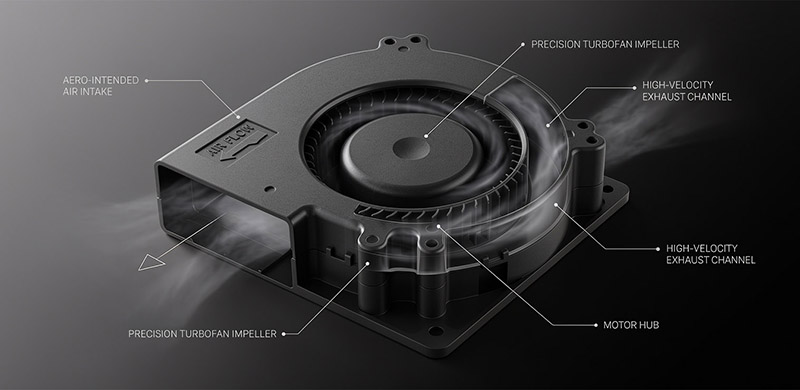
Motor input power tells you how much electricity the unit draws. It says almost nothing about how much acrylic dust reaches the filter. A 15W axial fan and a 65W centrifugal fan can both advertise strong suction, then behave nothing alike once dust starts loading the media.
Centrifugal fans keep pulling when resistance rises. Axial fans stall. That is the whole difference, and it is why our ES-801 runs a 65W centrifugal unit at 0-3500 RPM while the ES-806B pushes fan speed to 4000 RPM at 60W. Two different trade-offs, one shared goal: keep the intake moving when the filter is half full.
Four things decide real performance:
- Airflow, measured in cubic metres per hour at the intake
- Static pressure in kPa, which predicts behaviour under filter load
- Intake geometry, the funnel that decides whether dust near the bit reaches the fan
- Filter surface area, because a small pleat pack clogs in a week of full-time work
Ask any supplier for those four. If the reply is a wattage figure, you have learned something about their engineering depth.
Entry tier versus professional tier
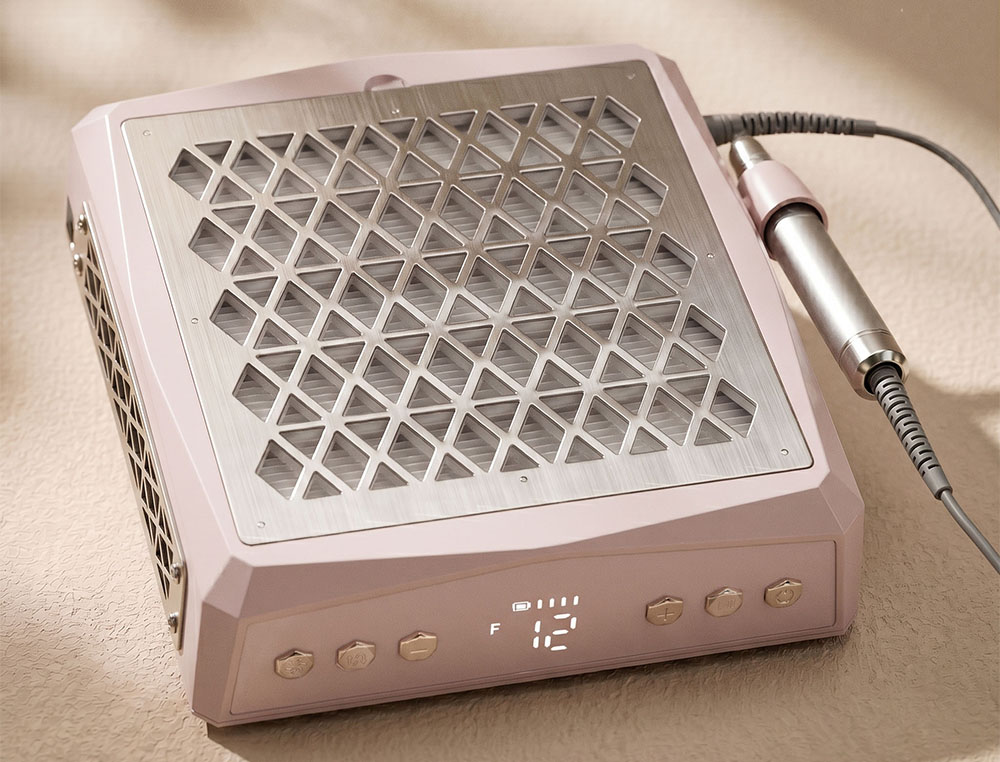
Entry units sit in the 15W to 18W band. Our ES-803 and ES-808 cover that range for single technicians doing light filing. Above 60W you are buying headroom: faster recovery between passes, longer intervals between filter cleans, and enough margin to run a 2-in-1 configuration without starving either function.
⚠
Visible dust is the small problemThe particles you can see settle on the desk. Respirable crystalline silica and fine acrylic dust do not. NIOSH lists respirable silica as a known carcinogen, which is why filter grade matters more than how clean the bench looks at the end of a shift.
Filters decide your long-term cost
A reusable mesh filter looks free. It is not. Mesh passes fine dust straight through, and that dust lands on your lungs, your clothes and your salon surfaces.
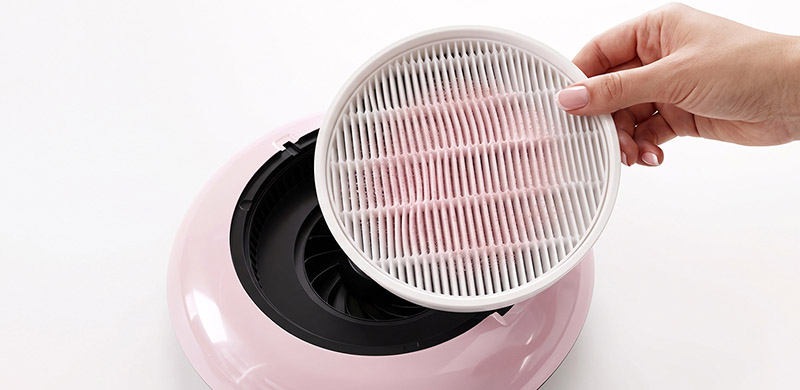
Pleated filters with higher capture rates cost more upfront and progressively reduce airflow as they load. A stainless steel pre-screen catches coarse grit and protects the pleats behind it. Our ES-801 and ES-801P use an ABS body with a stainless steel fan housing, so the abrasive parts outlast plastic-only designs that wear at the impeller edge.
Cleaning habits matter more than grade. Shake the filter after every session. Wash reusable mesh weekly in lukewarm water and let it dry fully before refitting. Replace pleated media when suction drops noticeably, not on a calendar. In our experience most salons wait months too long, then blame the motor for weak pull.
| Specification | ES-801 | ES-801P | ES-806B |
|---|---|---|---|
| Power | 65W | 85W | 60W |
| Fan speed | 0-3500 RPM | 0-3500 RPM | 0-4000 RPM |
| Fan type | Centrifugal | Centrifugal | Centrifugal |
| Body material | ABS + stainless steel | ABS + stainless steel | ABS + stainless steel |
| Battery | 2600mAh | 2600mAh | 2600mAh |
| Color | White | White | Pink |
💡
Buy one spare filter setRotating two filter sets lets you work while one dries. It costs less than a single replacement motor and removes the temptation to refit damp media.
Noise: the number nobody prints
Noise is the spec omitted from most listings and the one your clients notice first. Sound pressure depends on distance, so demand dB(A) at one metre. Anything else is meaningless.
A 65W centrifugal collector with a clean filter typically lands between 55 and 70 dB(A). That sits around the level of a raised conversation. Cheap units rattle because the fan assembly and housing are bolted together with no damping between them.
Brushless motor architecture is where we spend most of our engineering time. Less vibration means less radiated noise, and the detachable bearing structure that comes with it extends motor service life by 40% or more. That is a maintenance number, not a marketing number. Fewer bearing failures means fewer units shipped back to a distributor.
If your market is noise-sensitive, budget for a damped housing and a weighted base before you budget for extra wattage.
Where a dust catcher for nails gets loud
Three failure points produce most complaints: a clogged filter forcing the fan to work harder, a loose impeller screw after transport, and a hard desk surface that amplifies vibration. Check all three before you file a warranty claim. Two of them are user-serviceable in under five minutes.
Matching a dust collector for nails to your salon setup
Station count drives the decision. One technician filing gel and acrylic needs 60W of centrifugal pull and a filter you can clean in a sink. Two adjacent stations sharing one unit needs more static pressure, because the second intake sits further from the fan.
Buyers searching for dust collector nails usually fall into one of two groups: salons replacing a worn-out unit on a fixed bench, and distributors building a catalog range. Salons should match the footprint to the desk cutout first, then the power. Distributors should think in tiers, because a single 85W flagship will not cover every price point in a region.
One note on the 2-in-1 suffix. Our ES-801P combines two functions in one housing. Confirm which second function you actually need before ordering, since a shared housing trades serviceability for bench space.
What we see with distributors
Regional distributors who order mixed containers get better sell-through when they stock one entry unit, one mid-tier and one flagship. Batch quality variance is the complaint we hear most about other factories, which is why every unit we ship is assembled, tested and packed in the same 12,000 sqm facility.
✓ Pros
- A 2-in-1 unit takes roughly half the bench footprint of two separate devices.
- One power cable and one filter to maintain instead of two.
- Higher power ceiling than most single-function entry-tier collectors.
✗ Cons
- If one function fails, both stop working until the unit is repaired.
- Service access inside a shared housing is tighter than on a standalone collector.
- Repair cost per incident runs higher than on a basic single-function model.
Frequently Asked Questions
How many watts does a nail dust collector need?
For one technician doing gel and acrylic work, 60W to 65W with a centrifugal fan is the practical floor. Our ES-801 sits at 65W and the ES-806B at 60W with a 4000 RPM fan. Below 20W you are capturing coarse filings only, which suits light filing or a mobile setup but not a full book of acrylic clients.
Do I need a HEPA-grade filter in a nail dust collector?
Higher capture rate is always safer, but the trade-off is airflow as the media loads. A practical compromise is a stainless steel pre-screen plus a pleated main filter. That combination catches coarse grit before it reaches the fine media, so suction holds for longer between replacements.
How loud should a dust collector be?
Ask for dB(A) at one metre. A well-damped 65W centrifugal unit typically measures 55 to 70 dB(A) with a clean filter. If a supplier quotes a noise figure without a distance, treat it as unverified. Vibration is the main cause of excess noise, so brushless motors and damped housings matter.
Can one dust collector serve two nail stations?
It can, but only if the unit has enough static pressure to hold pull at the far intake. Splitting a 15W unit across two desks will disappoint both stations. Step up in the 60W to 85W range, or run one unit per technician and avoid the compromise entirely.
What is the MOQ for custom-branded dust collectors?
Our OEM minimum order is 500 units. Prototype lead time runs 1-2 weeks and production takes about 30 days. Customization covers logo, color to any RAL or Pantone reference, packaging format, plug type (EU, UK, US, AU or Type-C), multilingual manuals and product labels.
Key Takeaways
- Request airflow and static pressure figures before you look at wattage.
- Budget for two filter sets from day one, not from the first clog.
- Specify dB(A) at one metre in writing, especially for client-facing salons.
- For OEM programs, start with 500 units and a 1-2 week prototype to validate the build.
Conclusion
Specify the unit around airflow, filter grade and measured noise, then confirm the manufacturer can supply replacement filters and bearings for the life of the product. Our factory has run 13 years without a parts gap, which matters more than any single spec sheet when you are stocking a region. Send us your target dB(A) and intake size, and our engineers will match a model or start a prototype within 1-2 weeks. Full collector specifications are listed on the nail dust collector range page, and OEM terms sit on the OEM/ODM page.
────────────────────────────────
ABOUT THE AUTHOR
Leo CEO
Leo leads ELESECRET, a nail equipment manufacturer based in Guangzhou,
China. Since 2012 he has helped salon owners, distributors and beauty
brands source and customise professional nail equipment — nail drills,
UV/LED lamps, dust collectors and pedicure systems — with transparent
specifications, real factory capacity and OEM/ODM programmes matched to
each partner's market.
Why Trust Me:
• 13+ years manufacturing nail equipment in Guangzhou
• 12,000 sqm factory with 100,000+ units monthly capacity
• 100+ patents across motors, curing optics and dust extraction
• Supplying distributors, salon chains and private labels in 35+ countries
▌"We focus on the continuous innovation and premium quality of our nail
▌equipment to lead the global industry. Our dedicated team commits to
▌providing professional, tailored business solutions and exceptional
▌support for every partner."
▌— Leo, CEO, ELESECRET