
LED Nail Lamp Wavelengths: 365nm vs 405nm Curing Guide
Tutorial
Quick Takeaways
- 365nm carries roughly 10% more energy per photon and cures the surface layer fast; 405nm travels deeper and reaches through pigment.
- Gel needs a dose of energy (irradiance x time). Bead count, reflector geometry and lamp distance change that dose more than the wattage printed on the box.
- Every ELESECRET nail lamp in the core line outputs both 365nm and 405nm, so base, color and top coats each find their photoinitiator.
- White and black color coats need thinner layers and longer cures than clear gels, at any wavelength.
- Eye protection matters more around 405nm because of visible violet glare; skin exposure matters more at 365nm.
365+405 nm
Wavelength pair across the core lamp line
120 W
Peak power, ES-601PRO
48 LED beads
Per head on ES-601 and ES-601PRO
100,000+ units/mo
Factory output capacity
Gel that stays tacky after a 60-second cure usually gets blamed on the gel. Most of the time the lamp is the weak link. Two wavelengths sit inside almost every modern led nail lamp, 365nm and 405nm, and they do different jobs. One attacks the surface. The other reaches the pigment layer underneath. Get the balance wrong and a soft white gel wrinkles while a clear top coat cures rock hard in 30 seconds. This guide covers what each wavelength does inside the film, why dose beats wattage, and which lines on a spec sheet actually predict cure performance.
365nm vs 405nm: what each wavelength does inside the gel
Photoinitiators are picky. Each one absorbs light only in a narrow band, and light outside that band passes straight through without starting the reaction. Photons do the work. Wattage only decides how many arrive.
Photon energy scales with wavelength. A 365nm photon carries about 3.40 eV, a 405nm photon about 3.06 eV. Higher energy means a better chance of splitting the initiator molecule near the surface. The trade-off is scattering: shorter wavelengths bounce around more and die out sooner inside a pigmented film.
405nm behaves the other way. It scatters less and reaches deeper into thick builder gel and through the pigment load in a color coat. The core ELESECRET nail lamp line runs both wavelengths together, printed as 365+405 nm on the housing.
| Property | 365nm | 405nm |
|---|---|---|
| Band | UVA, invisible to the eye | Visible violet |
| Energy per photon | About 3.40 eV | About 3.06 eV |
| Penetration in a gel film | Surface to mid layer | Deeper, through pigment |
| Weak at curing | White and dark color coats | Thick clear builder layers |
| Practical risk | Higher UV exposure at 365nm | Bright violet glare at 405nm |
Photon energy favors 365nm
Surface cure lives here. The top 50 to 100 microns of a clear coat crosslink fastest under 365nm, which is why a thin top coat can feel dry in 30 seconds. It is also why the same lamp struggles with a 1mm bead of builder gel.
Penetration favors 405nm
Longer wavelength, less scatter. 405nm pushes further into the film and reaches the bottom of a color coat where the pigment load blocks shorter light. A thick white coat that stays soft underneath under 365nm alone often firms up once 405nm is added to the cycle.
Why one gel system contains two or three photoinitiators
Base, color and top coats are formulated separately, often with different initiators. TPO-type initiators absorb strongly between roughly 380nm and 420nm. BAPO-type initiators cover a wider window that reaches down to 365nm. If a lamp is missing one end of that range, one coat in the system stays undercured even when the surface feels dry and the client leaves happy.
Layer thickness beats every wavelength argument
A 2mm blob of builder gel will not cure through at 405nm in 60 seconds, whatever the label claims. Keep application layers under 1mm and cure in two passes. Wavelength decides where the light goes; thickness decides whether it gets there.
Wattage is not dose: how an led uv lamp for gel nails actually cures
A 96W lamp and a 120W lamp can deliver the same dose to a fingernail. Wattage is the electrical draw of the whole unit. Dose is what lands on the gel, and it equals irradiance multiplied by time. Two levers control it: how much light reaches the nail plate, and how long it stays there.
This is why a cheap led uv lamp gel nails bundle underperforms. The numbers on the box look generous, but the light is spread across a large opening, aimed sideways, or measured at the beads instead of at the hand.
Bead count per watt
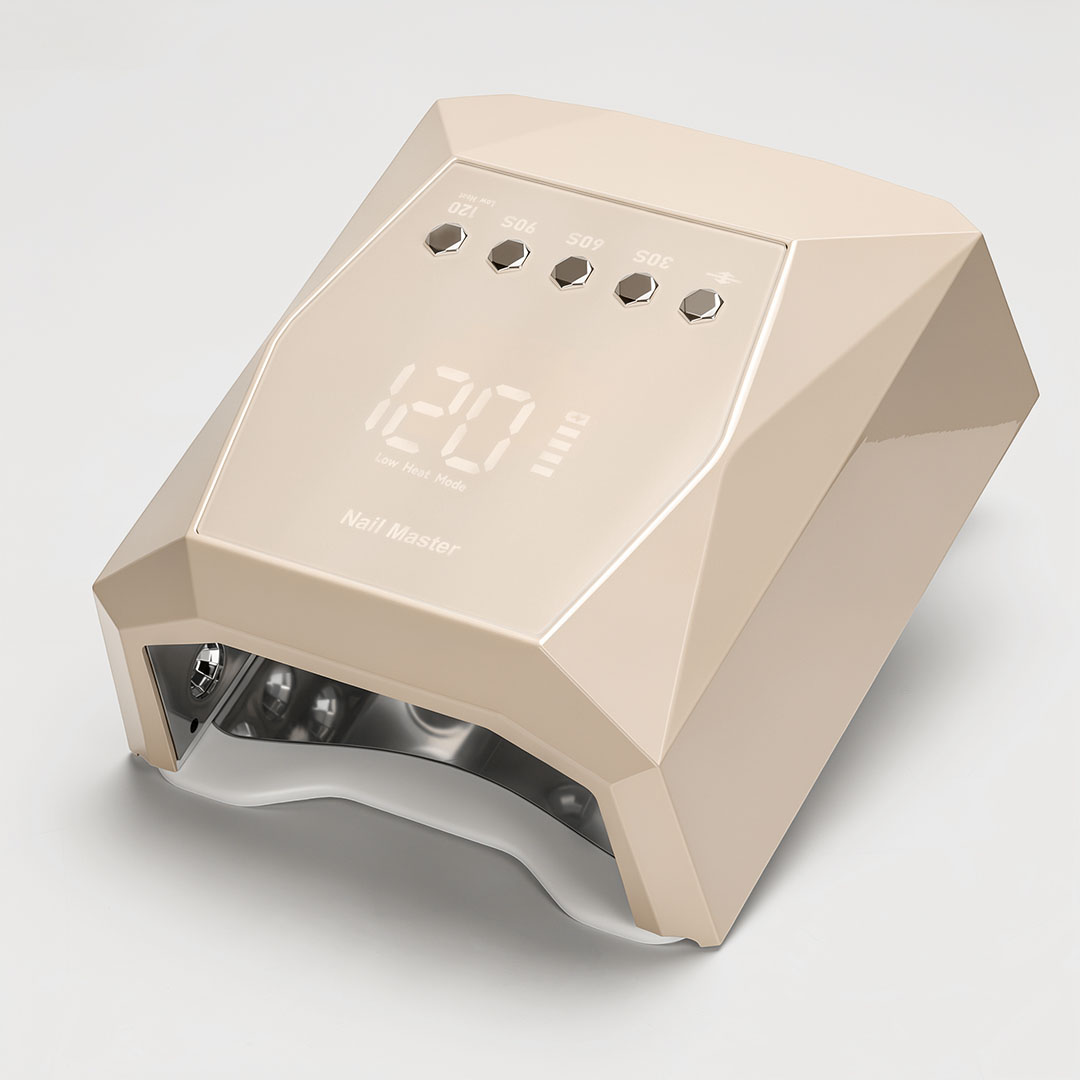
ES-601 spreads 96W across 48 beads, roughly 2W per bead. ES-606 puts 115W into 45 beads, about 2.56W each. ES-601PRO runs 120W over 48 beads at 2.5W each. More beads at a similar total power means a wider, flatter field, so five fingers cure in one pass instead of two.
Reflector geometry and distance
A bare LED throws a cone. A shaped reflector cup redirects the sideways light back onto the nail plate, which raises usable irradiance without adding a single watt. Distance then eats the gain. Moving the nail plate from 3cm to 6cm cuts irradiance to roughly a quarter, following the inverse square law. Rest the hand on the base, not above it.
Measure once, then stop guessing
A radiometer costs less than a single redo appointment per week. Read irradiance at the nail position, multiply by cure seconds, and you have a dose figure you can compare across lamps instead of trusting a wattage badge.
Matching wavelength and cure time to the coat you are applying
A gel manicure led lamp that shows 365+405 nm on the housing covers more formulation types than a single-wavelength unit. Cure time still has to move with the pigment in front of you.
Clear coats are forgiving. Pigmented coats are not. Set a default cycle, then adjust it for the two or three shades that always cause trouble.
Base and bonding layers
Clear and thin, so they cure quickly under either wavelength. Thirty seconds is typical under a dual-wavelength head. The common failure is a base coat that pools at the free edge and stays soft underneath while the rest of the nail is fine.
Color coats, especially white and black
Titanium dioxide white reflects visible and near-UV light back out of the film. Carbon black absorbs it before it reaches the bottom of the layer. Both leave the underside of the color undercured while the top feels hard. Two thin coats beat one thick coat at any wavelength, and a 60-second cycle is a safer default than 30.
Top coats, flash cure and detail work
Surface cure is 365nm territory, which is why a no-wipe top coat firms up fast on a dual-wavelength head. For nail art, a flash lamp does the tack cure before the hand goes into the main unit. ES-602 runs 9W across 3 beads and ES-603 runs 3W on a single bead, both at 365+405 nm. The ES-610 table lamp at 18W and 3 beads suits isolated detail work where a full hand cure is overkill.
What to check on a uv led nail lamp spec sheet
Six lines decide whether a unit will cure gel on a busy salon floor: wavelength pair, bead count, total power, head format, battery capacity and certification marks. Everything else is marketing.
Battery capacity separates cordless models in daily use. ES-601 carries 2600mAh, while ES-601PRO, ES-606 and ES-E607 carry 5200mAh. On a full column day, that difference shows up around the third hour.
| Model | Power | Beads | Wavelength | Battery |
|---|---|---|---|---|
| ES-601 | 96W | 48 | 365+405 nm | 2600mAh |
| ES-601PRO | 120W | 48 | 365+405 nm | 5200mAh |
| ES-606 | 115W | 45 | 365+405 nm | 5200mAh |
| ES-E607 | 96W | 48 | 365+405 nm | 5200mAh |
| ES-610 (table lamp) | 18W | 3 | 365+405 nm | 2000mAh |
✓ Pros
- Dual-wavelength output covers base, color and top coats from one unit.
- Higher bead counts spread the dose evenly across all five fingers.
- Battery models keep the cable off the desk during a full column.
✗ Cons
- A dual-wavelength head costs more per unit than a single-wavelength head.
- More beads add weight and heat to the head.
- Cell capacity fades with age, so service life tracks the battery, not the LEDs.
Eyes and skin: practical rules for led nail light exposure
The 365nm output sits inside the UVA band. The 405nm output is visible violet, which is why the glow looks so bright on camera. Neither is a reason to panic, and neither is a reason to skip basic protection.
Wear UV-blocking gloves if you cure dozens of sets a day. Do not lean into the lamp mouth to inspect a cure; cure first, then look. Keep the head closed or face down when idle, and angle it away from the client's eyes during the cycle. For technicians who work under the lamp for eight hours, these habits matter more than the wavelength printed on the housing.
Choosing the right led lamp for nails, from salon floor to private label
Salon chains buy on uptime. Distributors buy on batch consistency. Brand owners buy on customization and lead time, and those three buyers end up asking the same question: who builds the lamp and who fixes it in year two.
ELESECRET has manufactured in Guangzhou since 2012, 14 years of OEM and ODM work across nail equipment. The factory runs 12,000 sqm with R&D, tooling, injection molding, assembly and testing on site, at 100,000+ units per month.
OEM MOQ starts at 100 units, prototypes ship in 1-2 weeks, production runs 30 days. Custom logo, color to any RAL or Pantone, packaging format and plug type (EU/UK/US/AU/Type-C) are all handled in house. Units carry CE, FCC, KC, RoHS, UKCA, ETL and CCC marks and a 3-year warranty.
Distributors typically pair lamp SKUs with nail drill bits and a nail dust collector in the same order, because the same buyer restocks all three.
Start with the nail lamps catalog and confirm the wavelength pair before you compare prices.
The one spec that must never be assumed
Ask for the wavelength pair in writing on the quotation itself. A lamp labeled 365+405 nm behaves differently from one that quietly ships 365+395 nm, and the difference shows up as undercured white gel three weeks after the container lands.
Frequently Asked Questions
Does 405nm cure gel as well as 365nm?
For thick or heavily pigmented layers, 405nm usually cures more completely because it penetrates deeper. For surface cure on clear top coats, 365nm does the job faster. That is why dual-wavelength heads run both at once rather than choosing one.
Why is my gel still tacky after curing?
Three usual causes: the layer is too thick for the light to reach the bottom, the lamp is too far from the nail plate, or the gel uses a photoinitiator that the lamp's wavelength range does not cover. Check layer thickness and hand position before blaming the product.
Can I use any LED lamp with any gel?
Most modern gels are formulated for a 365+405 nm output, so a dual-wavelength lamp is the safest match. A single-wavelength lamp may undercure specific base or color coats even when the top coat feels dry.
How long should I cure each layer?
Thirty seconds works for thin clear base and top coats under a dual-wavelength head. Pigmented color coats, especially white and black, need 60 seconds and two thin passes. Always confirm against the gel manufacturer's stated dose.
Is 405nm light harmful to the eyes?
405nm is visible violet light and creates glare that is uncomfortable at close range. Keep the lamp head angled away from the face, avoid staring into the opening during a cycle, and use the closed position when the lamp is idle.
Key Takeaways
- Buy lamps that state both 365nm and 405nm on the housing, not in a brochure footnote.
- Compare bead count and total power together: 96W over 48 beads is roughly 2W per bead.
- Cure white and black color coats in two thin layers at 60 seconds each.
- Rest the hand on the lamp base; doubling the distance cuts irradiance to about a quarter.
Conclusion
Wavelength decides which coat cures. Dose decides whether it cures at all. Get the pair right, keep layers thin, and stop measuring lamp performance by the wattage badge alone. If you are specifying lamps for a salon group or a private label line, send your target wavelength pair, bead count and plug type to the OEM/ODM service team and ask for a prototype timeline; 1-2 weeks is the standard build window, with production at 30 days from approval.